News Studios Never Sleep
News Studios Never Sleep
A theatre production has a run. It opens, it performs for weeks or months, and eventually it closes. The set gets struck, the workshop moves on. Broadcast is a different proposition entirely. A news studio goes live every morning and has to look exactly right every time, with no understudy and no safety net. The tolerance for error is essentially zero, because the error would happen in front of however many people are watching.
That particular pressure shapes how broadcast sets are designed, built, and installed, and it is one of the things that make this kind of work genuinely distinct from the rest of what Scott Fleary does.
A studio built for three shows before lunchtime
In January 2026, ITV’s daytime programming relocated from Television Centre to The Hospital Club in Covent Garden, a building with a history that predates its life as a media venue by a considerable margin. St Paul’s Hospital until 1992, then a club and studio facility from 2004, the site now houses ITV Studios across two floors, with the primary studio in the basement.
Scott Fleary provided the fabrication for the project, working to a scenic design by Peter Aston of Jago Design. The brief was specific and demanding. The studio needed to serve three distinct programmes airing back to back between 9am and 1pm, with minimal reset time between each broadcast. Getting the set in was itself a challenge. Access to the basement was restricted to a small lift and standard double doors, which placed real constraints on what could be brought in and how it could be assembled once inside.
The result is a 360-degree environment covering around 2,600 square feet. This Morning occupies most of the space, with a faux living room, a kitchen area and a secondary table, all anchored by a large couch and a backdrop depicting the London skyline and the Thames. Lorraine and Loose Women share a corner of the studio built around an arcing LED display, with movable elements and virtual set extensions creating distinct looks for each programme. Lorraine’s area features a bright palette, rippled-glass video wall graphics, and a marble coffee table. Loose Women works around a custom desk with backlit layered frontage and floating screens for topic display.
Three different programmes, one studio, a new set every hour. The construction has to make that possible without the joints showing.
Building sets that go somewhere difficult
Not all broadcast construction happens in a fixed facility. Sports coverage, in particular, tends to place production in environments that were never designed with television in mind, which creates a different set of problems entirely.
For Roland Garros 2025, Scott Fleary was appointed by TNT Sports and Warner Bros. Discovery to deliver the complete scenic build for their international broadcast of the tournament. The brief began as a UK studio build and grew considerably as the project developed. By the time it was finished, the team had fully clad and fitted out a large modular truss pavilion in the Plaza de Mesquitère at Stade Roland Garros, housing both UK and US studio spaces, plus a late-addition elevated outdoor platform with direct views of the courts. All of it was delivered within a five-week build window.
The Plaza de Mesquitère is Roland Garros’ equivalent of Wimbledon’s Henman Hill, the main fan gathering area for the tournament, and TNT Sports deliberately placed its studio right in the middle of it. The positioning gave the coverage an authenticity that an interior studio cannot replicate, though it also brought real construction challenges. Trees and light poles within the footprint required multiple rounds of design revision before a workable solution emerged, and the final structure incorporated those natural elements rather than simply working around them.
The pavilion required advanced weatherproofing and wind-load reinforcement, with dimensional tolerances tight enough to accommodate the camera and lighting infrastructure already planned for the space. The outdoor cantilever structure incorporated anti-slip decking and integrated anchor points for a 30-foot jib. Glass panels in the studio design could be removed on good weather days, opening the space into the surrounding fan zone. Coordinating across time zones with the US production team, responding to design revisions that continued well into the build phase, the project was delivered on time and to specification. Roland Garros 2025 became one of TNT’s most successful sports events to date, drawing over 620 million views across Europe.
Engineering down to the millimetre
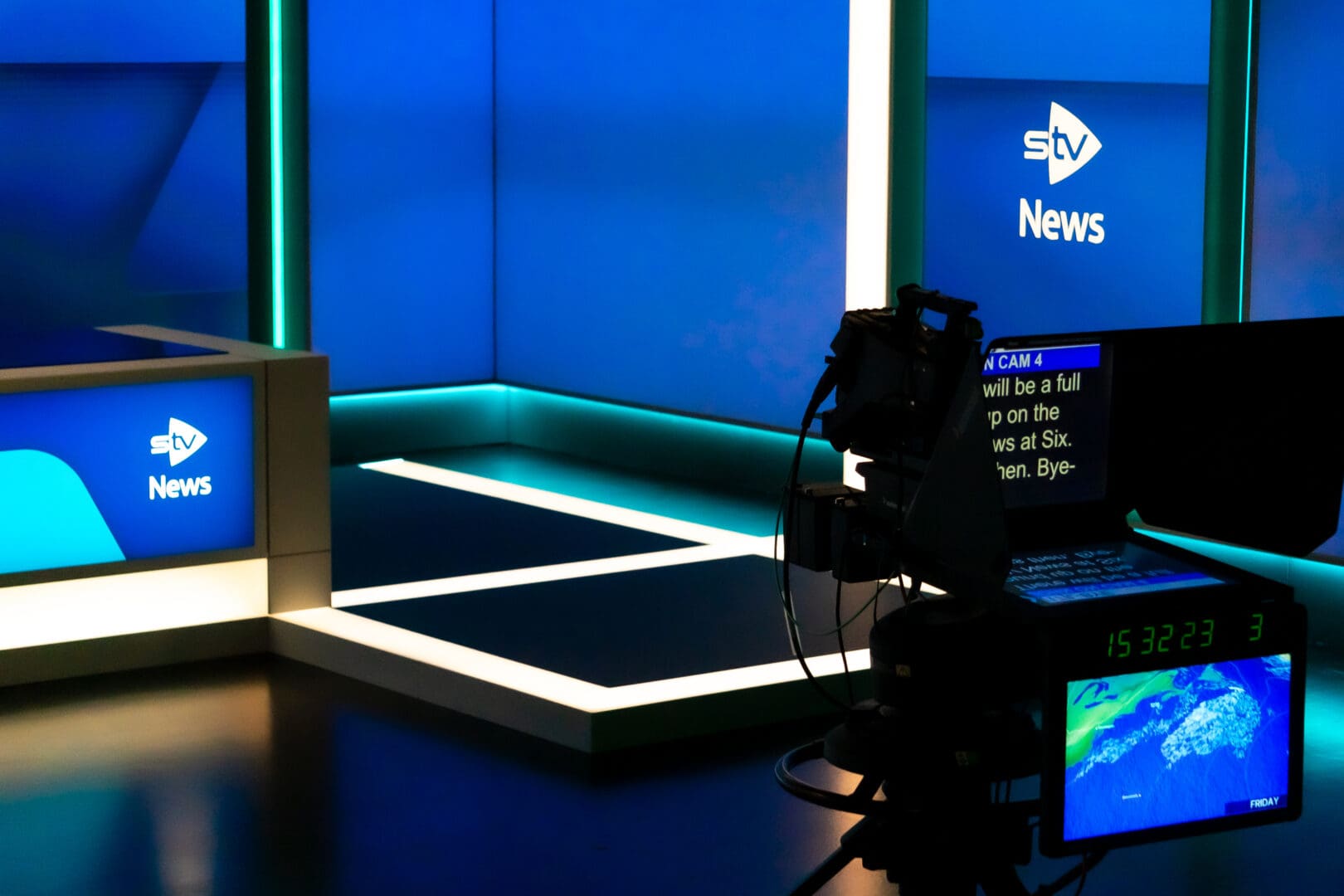
The STV news studios in Glasgow and Aberdeen represent a different kind of challenge again. Scott Fleary was appointed to deliver the scenic construction for both sites following STV’s decision to invest significantly in its broadcast infrastructure, working to a design by Toby Kalitowski. All modular elements were prefabricated and tested at Scott Fleary’s South London workshops before being transported and installed on location.
The scope covered risers, LED screen walls, lightbox walls and anchor desks, with bespoke scenic engineering, integrated LED lighting and precision metalwork throughout. The relationship between the LED floor lightboxes, wall lightboxes and ceiling pieces was engineered to millimetre tolerances to ensure the combined visual read as a continuous and unbroken environment on camera. Each studio is built around three dynamic video walls, designed to give presenters greater freedom to move around the space and allow reporters to join them on set.
The studios now serve as the backdrop for STV News at Six and STV News at Lunchtime, Scotland’s most-watched news programme, which reaches audiences across 13 platforms and delivers up to 50 million views per month across digital channels.
What broadcast demands that theatre does not
The common thread across all of this work is that there is no room for a set to need adjusting once it goes live. In theatre, a technical rehearsal exists partly to find and fix problems before an audience arrives. In live broadcast, the audience is already there. A news studio that goes on air at six o’clock in the morning has to perform at six o’clock in the morning, not once things have been bedded in.
That reality runs through every decision made during the design and construction phase. It is why prefabrication matters as much as it does, why tolerances have to be precise, why the relationships between physical elements and the technology integrated within them have to be resolved before anything leaves the workshop. The set being finished is not the end of the process. It is the moment the process has to have been done correctly.
Still Have Questions?
Our friendly team is here to help you out.