Why an Apprenticeship in Creative Construction Might be the Smartest Career Move You Make
Why an Apprenticeship in Creative Construction Might be the Smartest Career Move You Make
What is creative construction and why does it matter?
When people think about working in theatre or television, their minds tend to go straight to the stage or the screen. What gets overlooked is the enormous amount of skilled work happening behind the scenes, work that makes every production possible. Sets have to be designed, engineered, built and installed. Studios need to be fitted out. Cruise ship theatres require scenery that can withstand life at sea. Every environment an audience or camera sees has been physically made by someone.
Creative construction sits at the centre of all of that. It covers scenic carpentry, engineering, scenic painting, and technical production, spanning industries from West End theatre to broadcast television to live events. The people who build these environments rarely get credit, yet their contributions shape everything the audience experiences. For anyone who loves the creative industries and wants a career within them, this world is full of opportunities that simply do not get talked about enough.
The problem with pushing everyone toward university
There is a well-documented pattern of schools pushing students toward university, and some of that pressure stems from funding. Schools receive incentives based on the number of graduates they produce, which can sideline apprenticeships and vocational routes. We spoke to Charli and Rollo, two previous apprentices and current employees at Scott Fleary, and both reflected on how strongly they had been steered toward university during their school years, without always understanding why.
Friends who left school and pursued apprenticeships across various trades are now doing extremely well, while some university graduates are finding the job market more difficult, particularly where certain degree subjects have become oversupplied. Tradespeople and skilled makers, on the other hand, are facing a growing shortage that is likely to push both demand and wages upward in the years ahead.
The financial picture is worth considering, too. A degree often comes with significant debt, while an apprenticeship pays a wage from day one and builds genuine experience.
On the job learning versus classroom theory
In our conversation with the apprentices, both were clear that the most valuable part of their training took place in the workshop, not in the classroom. Being surrounded by people who had spent decades in the industry meant that knowledge was absorbed naturally, through doing and observing rather than through formal instruction alone. That kind of transfer is difficult to replicate in a schooling setting, making it one of the strongest arguments for the apprenticeship model.
The format works because it combines structured education with daily practice. There is real potential for the college element of apprenticeships to develop further, and the introduction of Level 3 programmes is a positive step in that direction. As training quality continues to improve, apprentices will graduate with qualifications that are stronger and more widely recognised across the industry.
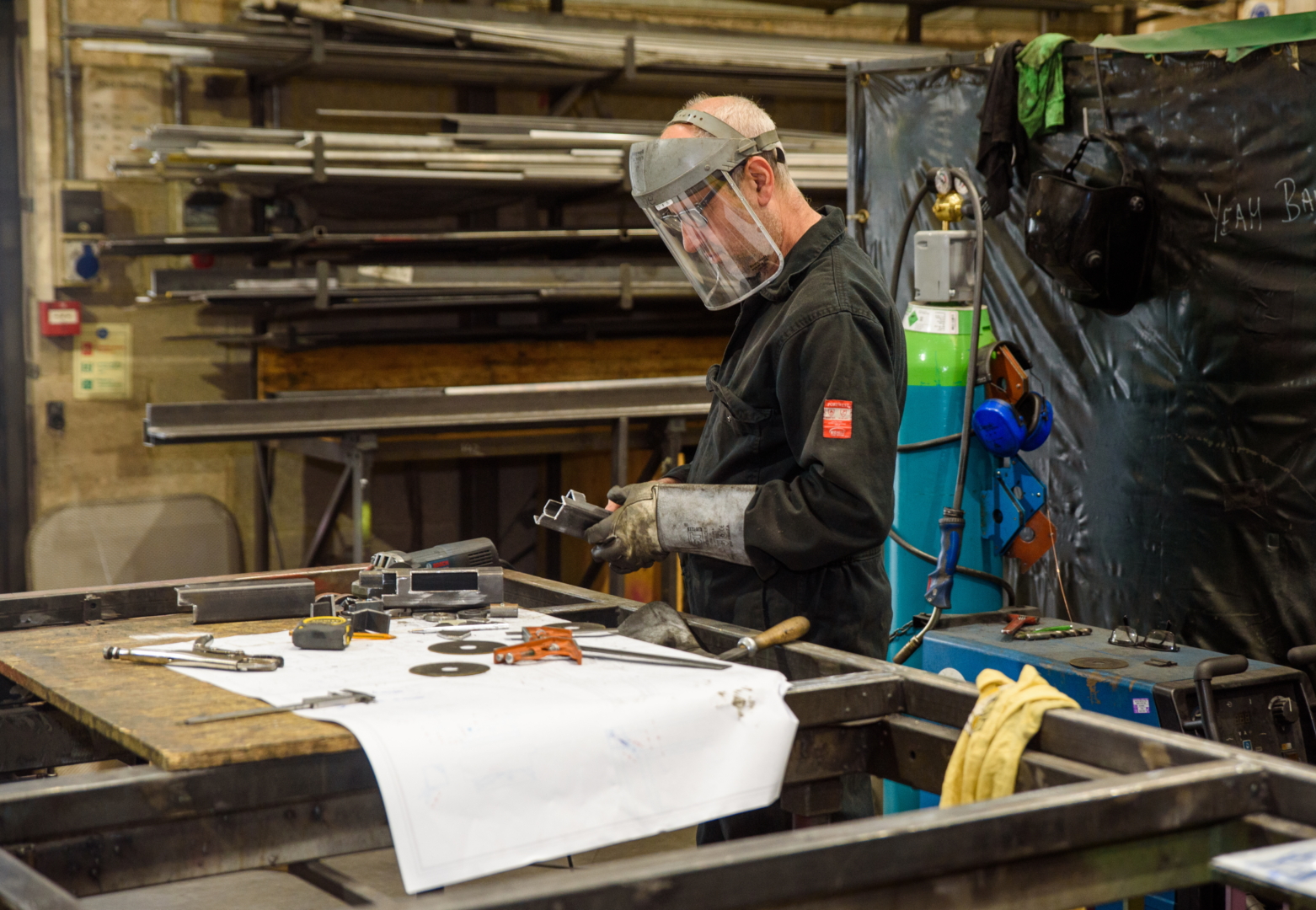
Scott Fleary’s Carpentry apprentice Archie is undertaking the Creative Alliance Scenic Construction Technician Level 3 Apprenticeship, equivalent to A levels, and one of the first programmes of its kind in the country. We also have Kruize who is our Engineering Apprentice. With Archie’s training delivered online, all of his practical learning takes place in the Scott Fleary workshop. As Archie explains, “every task is relevant to the niche industry that is scenic construction,” and working with his mentor, Tom, means he can refine his technique in a way classroom learning rarely allows. The course has also pushed him to develop skills outside his comfort zone, including seminars and modules covering CAD and Affinity, which have given him a deeper understanding of the design thinking behind the scenery being built. With only a small number of providers nationwide, Scott Fleary’s involvement in the first cohort reflects a genuine commitment to developing the next generation of makers.
In our conversation with the apprentices, the gateway that an apprenticeship provides came up clearly. As one of them put it, coming in through an apprenticeship felt like a far simpler and less pressured route into the industry than applying for a job directly. The experience built over two or more years means that by the end, apprentices are not starting from scratch. They arrive at the next stage of their career with real capability and a solid understanding of how the industry works.
How Theatre People support the process
Theatre People, co-directed by Bendy Ashfield, works across the creative industries, supporting inclusive recruitment, workforce development, and thoughtful HR practices that help organisations attract talent from a wider range of backgrounds.
Their work with Scott Fleary includes supporting apprentices through the process, maintaining regular communication and check-ins, and helping craft job descriptions that speak clearly to people with no prior industry knowledge, including parents and carers who need to understand why an apprenticeship is a credible and worthwhile path.
One of their central aims is to make backstage careers more visible. Too many people who love theatre or television assume the only route is performance, and the breadth of technical and construction roles available often goes unnoticed until it is too late to change course.
“Apprenticeships combine practical work with learning and give people real experience over time. After two or three years, apprentices are confident and capable; they often stay on with their employer. It’s taken a long time for us to prove the value of apprenticeships rather than going to University, and we believe we’re finally getting to a place where we can confidently say they’re a great, if not better option, especially for roles in the creative industries. It opens up young minds to a world beyond the careers on stage”.
At Scott Fleary, apprentices work alongside one another, which creates a layer of mutual motivation that formal training rarely provides on its own. Nathan, who joined as an apprentice and is now Head of Carpentry, is a clear example of where this path can lead. With Charli and Rollo now working full-time at the company, and Archie progressing through a brand new Level 3 programme, the workshop reflects a culture of genuine development. The routes into this industry are there, and they deserve to be far better known.
We will always have a home for apprentices at Scott Fleary.
Still Have Questions?
Our friendly team is here to help you out.